
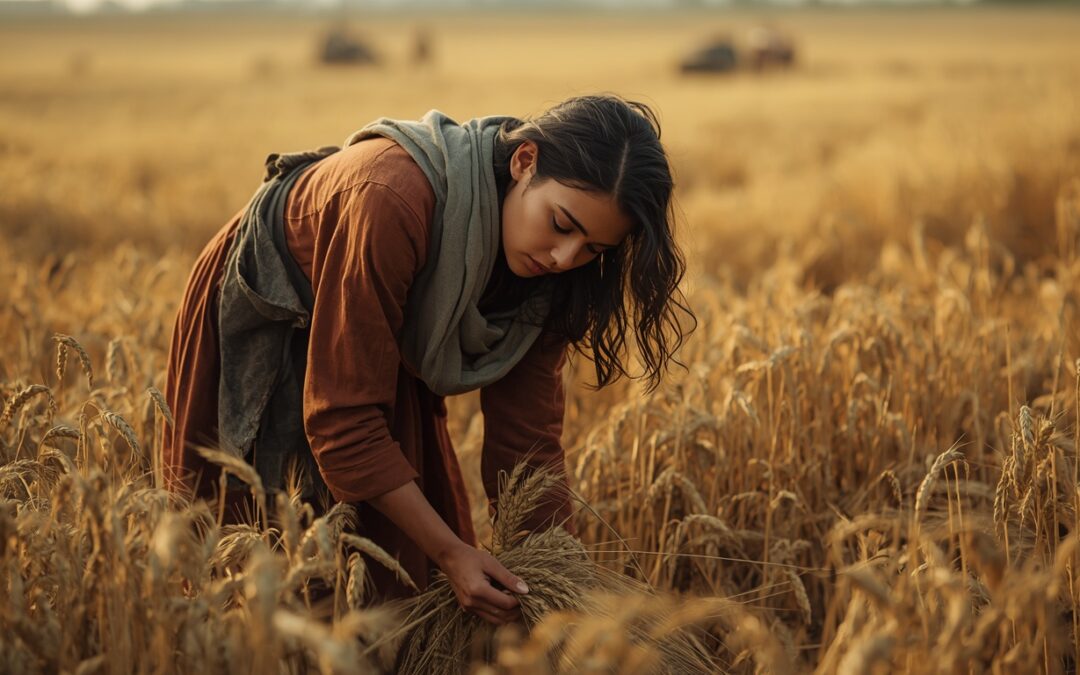
The Woman Who Bloomed In Someone Else's Field
Ruth's Yes Wasn't a Moment. It Was Every Morning.
Last episode we sat with Mary — a teenage girl who said yes to God when yes could have cost her everything. That was a single, dramatic moment of surrender.
Ruth's story is different. Her courage wasn't dramatic. It was daily.
It happened in the dark, when nobody was watching. In a foreign field, doing back-breaking work, in a country that wasn't hers, for a family that wasn't originally hers either. And for most of us — that quieter, unglamorous, show-up-anyway kind of faithfulness is actually the harder kind.
By the time we're done today, you're going to see your own ordinary faithfulness in a completely different light.
The world she walked into
An Outsider in Every Way That Mattered
To understand Ruth's story, you need to feel the weight of one word: Moabite.
To a first-century Jewish reader, that word was a warning label. The Moabites were a neighboring nation with a hostile history with Israel — different gods, different customs, different everything. Deuteronomy 23 explicitly excluded Moabites from the assembly of Israel, even to the tenth generation.
Ruth was, in the eyes of the culture she was entering, the wrong nationality, the wrong religion, the wrong background.
Then layer on the time period. The book of Ruth opens with four words that should make every reader's heart sink: "In the days when the judges ruled." That single phrase tells us everything. The period of the Judges was one of the darkest, most chaotic seasons in Israel's history — a time of repeated moral collapse, violence, and spiritual unfaithfulness, summarized by one devastating sentence: everyone did what was right in their own eyes.
Into that world, Ruth steps forward as one of the most quietly radical figures in all of scripture.
Her husband had died, along with his father and brother, leaving three widows with nothing. In the ancient Near East, a widow without a male protector was extraordinarily vulnerable. No social safety net. No pension. Your survival depended on the mercy of others — or on a kinsman-redeemer, a male relative who could marry you and restore your family's standing.
Ruth had none of that. She was a foreign widow in a hostile world. And what she chose to do next changed everything.
Ruth 1:16–17
"Where You Go, I Will Go"
When Naomi decided to return to Bethlehem, she released her daughters-in-law. Go home, she told them. Find new husbands. Start over. Orpah wept, kissed Naomi goodbye, and left — and I want to be careful here, because Orpah is not the villain of this story. She made the sensible choice. She went home.
But Ruth clung to Naomi. And then she spoke one of the most beautiful declarations of loyalty in all of human literature.
"Where you go I will go, and where you stay I will stay. Your people will be my people and your God will be my God. Where you die I will die, and there I will be buried."
— Ruth 1:16–17
Read that slowly. Because Ruth isn't just making a promise to an old woman. She is making a declaration of faith. Your God will be my God. She is leaving her culture, her religion, her homeland, and her safety — voluntarily — to follow someone who had nothing left to offer her.
What was in Ruth's hands? Loyalty. A willingness to show up for someone else when there was absolutely nothing in it for her.
They arrive in Bethlehem at the beginning of the barley harvest. And Ruth doesn't wait around. She doesn't feel sorry for herself. She asks Naomi: let me go to the fields. Let me work.
Gleaning was the ancient equivalent of picking up leftovers — the law commanded that farmers leave the edges of their fields for the poor, the widow, and the foreigner. It was hard, humbling, physical work. You walked behind the harvesters all day in the sun, picking up whatever they left behind.
Ruth shows up anyway.
And as it happens — and I love how the Bible phrases this, as it happens — she finds herself in the field belonging to Boaz. A man of standing. A relative of Naomi's late husband. A kinsman-redeemer.
"Why have I found such favor in your eyes that you notice me — a foreigner?"
— Ruth 2:10
Boaz had already heard about her. He tells her: I know everything you've done for Naomi. I know you left your homeland and your people. And then he says something extraordinary:
"May you be richly rewarded by the Lord, the God of Israel, under whose wings you have come to take refuge."
— Ruth 2:12
Under whose wings you have come to take refuge. That is the language of covenant. That is the language of belonging. Boaz saw Ruth not as a foreigner to be tolerated, but as a woman who had placed her faith in the living God.
The rest of the story moves toward redemption. Boaz marries Ruth, restores her family's land, and gives Naomi a grandson named Obed. That grandson becomes the grandfather of King David. And from that lineage — from Ruth the Moabite, the foreign widow who gleaned in a stranger's field — comes the line that leads all the way to Jesus.
She had no idea. She just showed up every morning to the field.
What it means for you
Blooming in Someone Else's Field
Maybe you're in a field that doesn't feel like yours right now. A job that isn't your dream. A city you didn't choose. A season of life you didn't plan for. A role — caregiver, single parent, rebuilder — that feels like gleaning. Like you're just picking up leftovers. Like everyone else got the abundant harvest and you're walking behind them hoping there's something left.
Ruth's story speaks directly to that feeling: God sees you in the field.
And the field you think is foreign, the field you think is temporary, may be the exact place where your breakthrough is waiting. Not necessarily a husband. But a divine intersection. A moment where your faithfulness is noticed by someone with the authority to change everything.
"She wasn't spectacular. She was faithful."
The workers told Boaz: she came in the morning and has not stopped working except for a short rest. That's it. She just kept showing up.
What's in your hands today? Maybe it's just consistency. Maybe it's the willingness to go back to the field one more time when you're tired and discouraged and not sure it's worth it. Maybe it's loyalty to someone who can't repay you — a parent, a friend, a calling that hasn't yet produced visible fruit.
Ruth didn't know she was writing a chapter of the greatest story ever told. She was just trying to make sure Naomi had enough to eat.
God has a way of taking ordinary, daily faithfulness and weaving it into something eternal. You may not see the full picture yet. But He does. And He is watching every morning you show up to the field.
"But Ruth replied, 'Don't urge me to leave you or to turn back from you.'"
— Ruth 1:16
This week's reflection
Ruth bloomed in a field that wasn't originally hers — through daily, unglamorous faithfulness. What "field" are you currently in that may feel foreign or temporary — and what would it look like to show up there with your whole heart this week?
Ready to go deeper? Listen to the Full Episode.
The podcast goes places this article can't — including a prayer for everyone who is tired of showing up to a field that feels invisible.
🎧 Listen on Spotify
🎧 Listen on YouTube