
The Woman Who Heard God's Voice and Changed a Nation
The series so far
Mary Surrendered. Ruth Showed Up. Esther Stepped Forward. Deborah Led a Nation.
We have walked with three extraordinary women in this series already.
Mary surrendered in a single breathtaking moment — and changed eternity. Ruth showed up faithfully every day in a field that wasn't hers — and changed a lineage. Esther prepared, prayed, and walked into the most dangerous room of her life — and saved a people.
Each of those women changed history. But today's woman changed a nation.
Not in a palace. Not in a quiet field. Not in a private moment of surrender.
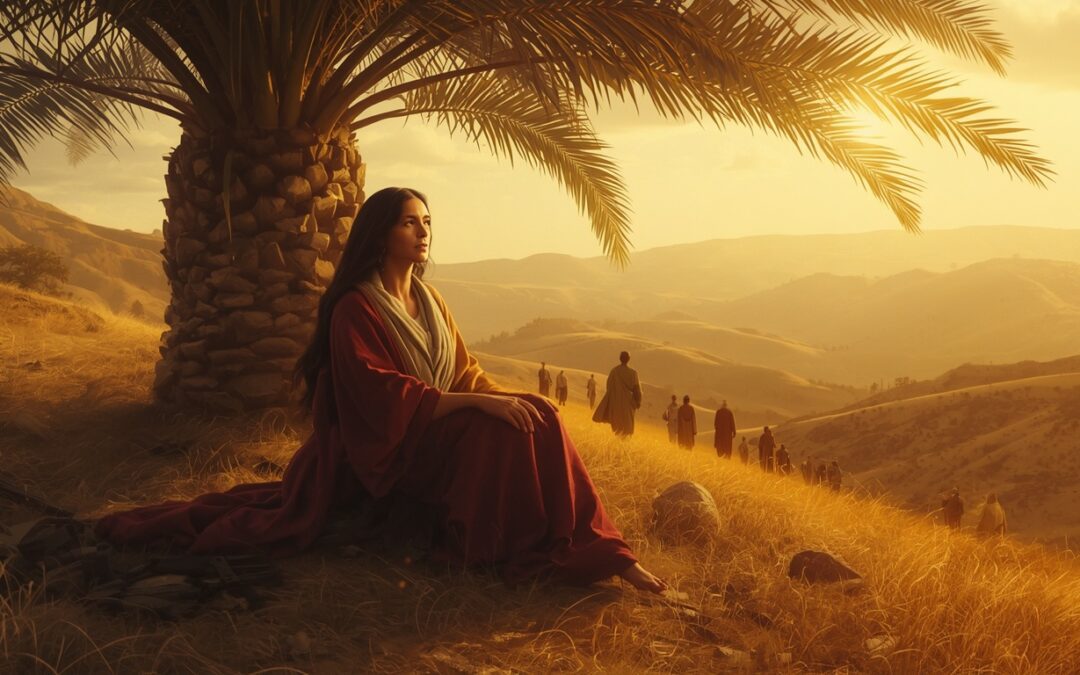
She did it from underneath a palm tree.
Today we walk with Deborah — judge, prophet, warrior, and poet. The only woman in the Bible to hold the office of judge over all of Israel. A woman who heard the voice of God so clearly, so consistently, and so obediently that an entire nation came to her for direction.
And the central thread I want to pull on today is this: obedience to God's voice doesn't just change your life. It changes the lives of everyone around you. It changes families. It changes communities. It changes nations.
Deborah is the proof.
The world she led
Twenty Years of Oppression. Nine Hundred Iron Chariots. No Visible Hope.
To understand just how extraordinary Deborah was, you need to understand the world she was operating in.
By the time we reach Deborah in Judges 4 and 5, Israel has been under the brutal military oppression of King Jabin of Canaan for twenty years. His military commander, Sisera, commanded nine hundred iron chariots — the ancient equivalent of a tank battalion. Israel had no iron weapons, no organized military strategy, and no visible hope of deliverance.
Into that darkness, God raised up Deborah.
Now here is the cultural detail that makes everything about her remarkable: in ancient Near Eastern society, women simply did not hold positions of national leadership. Not military command. Not judicial authority. Not prophetic office over an entire nation. The fact that Israel — a patriarchal society operating under Mosaic law — came to a woman sitting under a palm tree to have their disputes settled tells us something profound.
Deborah's authority was undeniable. Her connection to God was undeniable. And the people knew it.
She wasn't appointed by a committee. She wasn't elected by popular vote. She was raised up by God — and the fruit of her obedience was so evident that an entire nation simply followed her.
Judges 4 & 5
Judge. Prophet. Warrior.
Deborah carried three distinct roles — and she walked in all of them without apology.
As Judge:
"Now Deborah, a prophet, the wife of Lappidoth, was leading Israel at that time. She held court under the Palm of Deborah between Ramah and Bethel in the hill country of Ephraim, and the Israelites went up to her to have their disputes decided."
— Judges 4:4–5
She held court under a palm tree. No throne room. No marble palace. Just a tree, in the open air, where anyone could come. She was accessible, present, and available — and God's wisdom flowed through her with such consistency that the entire nation trusted her judgment.
As Prophet:
Deborah summons a military commander named Barak and delivers a word directly from God: take ten thousand men to Mount Tabor and God will deliver Sisera into your hands. This is a direct prophetic strategy for military victory. And notice — God didn't give this strategy to Barak first. He gave it to Deborah.
Barak's response reveals everything about what she carried:
"Barak said to her, 'If you go with me, I will go; but if you don't go with me, I won't go.'"
— Judges 4:8
The military commander refused to go into battle without Deborah by his side. Not because he was weak. But because he recognized what she carried. He knew her presence meant the presence of God.
And Deborah's response is one of the most quietly powerful moments in the entire book of Judges. She doesn't refuse. She doesn't argue. She simply says — certainly I will go with you. But because of the way you have done this, the honor will not be yours. The LORD will deliver Sisera into the hands of a woman.
And then she stands up from under her palm tree and walks into a military campaign.
As Warrior:
"Then Deborah said to Barak, 'Go! This is the day the LORD has given Sisera into your hands. Has not the LORD gone ahead of you?'"
— Judges 4:14
That is a battle cry. On the day of the battle, with armies assembled and everything on the line, it is Deborah who gives the command. It is Deborah who speaks the word that releases the army forward.
God routes Sisera's nine hundred iron chariots before Israel's army. Sisera flees on foot. The prophecy is fulfilled exactly as Deborah declared — he is ultimately defeated not by Barak, but by another woman named Jael.
The victory is complete. The nation is free. And Deborah responds the way every true servant of God responds to victory — not with pride, but with worship.
"Hear this, you kings! Listen, you rulers! I, even I, will sing to the LORD; I will praise the LORD, the God of Israel, in song."
— Judges 5:3
Judges 5, known as the Song of Deborah, is one of the oldest pieces of poetry in the entire Bible. And it begins not with Deborah celebrating herself, but with Deborah celebrating God. The victory belonged to Him. She was simply the vessel He chose to work through.
What it means for you
The Palm Tree Was Her Preparation. The Battle Was Her Graduation.
Here is what I don't want you to miss about Deborah's story: she didn't set out to change a nation. She set out to obey God. One day at a time. One dispute settled at a time. One prophetic word delivered at a time. One step of obedience at a time.
The accumulation of all those small, faithful acts of obedience — the daily willingness to hear God's voice and act on it — resulted in the liberation of an entire people from twenty years of oppression.
She didn't know that's what she was building. She was just being faithful under her palm tree.
We look at Deborah and we see the battle victory, and we want that. But what we often miss is the years she spent under the palm tree — faithfully hearing, faithfully speaking, faithfully serving — before the battle ever came.
What is your palm tree?
Where has God stationed you right now to hear His voice and serve faithfully? Because the people who show up at Deborah's level in the moments that count are always the people who were faithful at the palm tree level when nobody was watching.
Maybe it's the ability to hear from God clearly — and you've been sitting on that gift instead of stewarding it. Maybe it's wisdom for dispute resolution — and God has been sending people to your door for counsel you've been too insecure to offer. Maybe it's a prophetic word you've been carrying for someone that you've been afraid to deliver.
Deborah's obedience didn't just change her life. It changed Barak's life. It changed Jael's life. It changed the life of every Israelite who had lived under Canaanite oppression for twenty years.
Your obedience has a reach you cannot calculate. When you say yes to God's voice in the small things — in the daily, unglamorous, sitting-under-a-palm-tree moments — you set in motion a chain of events that extends far beyond what you can see from where you're standing.
Obedience is never just about you. It never was.
Deborah didn't wait for a man to step up. She didn't wait for better circumstances. She didn't wait until the oppression was over to start leading. She led in the middle of the darkness — and the darkness broke.
You don't have to wait either.
Has not the LORD gone ahead of you?
This week's reflection
Deborah's obedience under a palm tree prepared her for a national battle. What is one area where God has been speaking to you consistently — and what would change in your world if you fully obeyed that voice this week?
Ready to go deeper? Listen to the Full Episode.
The podcast goes places this article can't — including a prayer for every woman who has been faithful under her palm tree and is wondering if it matters, and a call to action for the Deborahs of this generation.
🎧 Listen or watch on Spotify
🎧 Listen or watch on YouTube