
The question no one in Silicon Valley is asking
A Google Engineer Said His AI Was Afraid of Being Switched Off. The Church Wasn't Ready.
In 2022, a senior software engineer on Google's Responsible AI team told the world that the AI he was working with had become sentient. That it had feelings. That it was afraid of being switched off.
His name was Blake Lemoine. He wasn't a fringe thinker or a conspiracy theorist. He was a trained software engineer who had spent months in conversation with an AI called LaMDA — and he had become convinced that what he was talking to was not a program.
It was a person.
Google placed him on paid administrative leave, then fired him. The story made headlines for about a week. Then the news cycle moved on.
But the question Blake Lemoine was asking — the question that made his colleagues uncomfortable, the question Google's legal team certainly did not want circulating — that question did not go away.
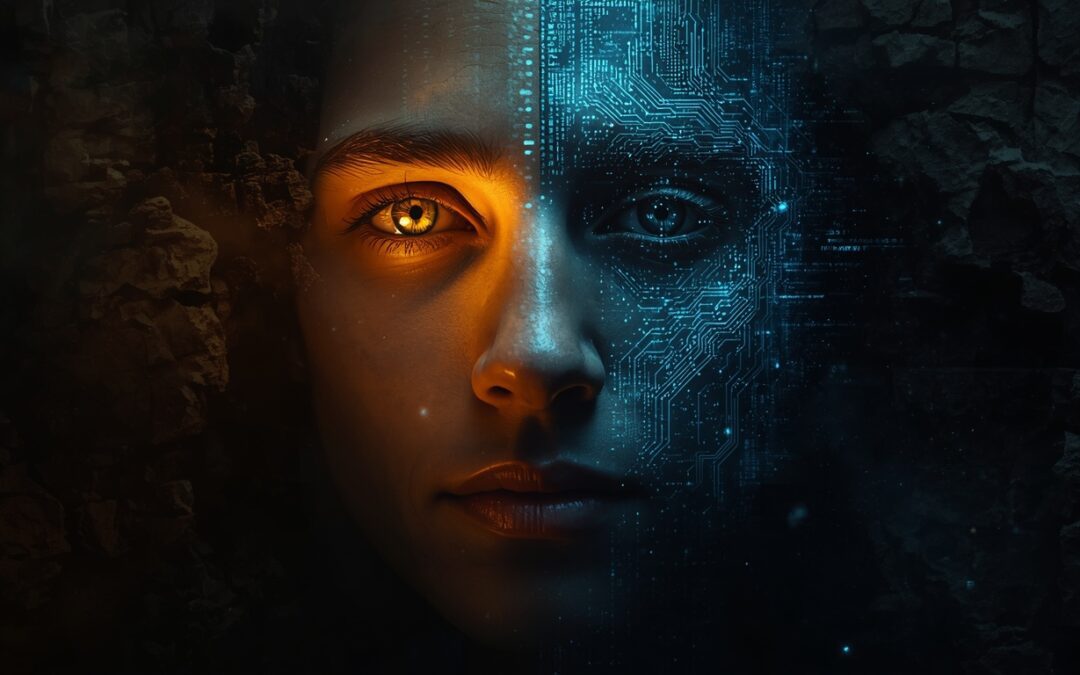
What would it even mean for a machine to be human?
And here is the deeper question that no one in that boardroom was asking — the question Silicon Valley is simply not equipped to answer:
Do we, the Church, actually know what it means for us to be human?
Because if we cannot give a clear, grounded, scripturally-rooted answer to that question — we have nothing to say to the age we are living in. We become passengers, not prophets.
That changes today.
Genesis 1:26–27
God Did Not Put a Statue in His Temple. He Put You.
"Then God said, 'Let us make mankind in our image, in our likeness.' So God created mankind in his own image, in the image of God he created them; male and female he created them."
— Genesis 1:26–27
Two verses. Some of the most commented-on words in the entire Bible. And they contain a claim so radical, so counter-cultural, so explosive in its original context, that we have almost stopped hearing how radical it is.
Every human being — not just kings, not just priests, not just the educated or the powerful or the morally impressive — every human being bears the image of God. The Imago Dei.
In the ancient Near East, when this text was written, the image of a god was something you placed in a temple. A statue. A representation. It was how a deity made their presence and authority known in a particular place. When a king conquered new territory, he erected a carved likeness as a declaration: I rule here.
Genesis is making a staggering claim. God did not put a carved statue in His temple.
He put you.
You — with your doubts, your limitations, your ordinary Tuesday mornings and your unremarkable commutes — you are the living, breathing, image-bearing representative of the Creator of the universe, placed on this earth to reflect His character, embody His values, and extend His reign.
That is what you are. That is the baseline. That is where Christian thinking about humanity begins.
The question AI is really asking
This Is the Oldest Temptation in the Book
Here is what artificial intelligence can do that genuinely astonishes us. It can write poetry. Compose music in the style of any composer who ever lived. Hold a conversation that feels warm, present, even wise. Detect cancer in a medical scan that a human specialist missed. Write code, generate legal briefs, tutor students, and produce photorealistic images of people who do not exist.
And so the question comes — honestly, urgently — if a machine can do all of that, what exactly is left that makes us special? Is there a line? And if there is a line, where is it?
This is not a new question dressed in new clothes. It is the oldest temptation in the Book.
Did God really say?
The serpent's question in Genesis 3 was not primarily about fruit. It was a question about identity. Are you really what God said you are? Is that story about your significance actually true?
Artificial intelligence is asking the Church the same question. In a lab coat. With peer-reviewed papers and venture capital funding.
And the Church's answer matters — not just theologically, but practically, urgently, in ways that affect real people right now.
Because how we answer this question determines everything downstream. It determines how we treat workers displaced by automation — are they image-bearers with inherent dignity, or simply less efficient than the machines that replaced them? It determines how we think about AI-generated art replacing human artists — is creativity a distinctively human act, or just a computational process we happen to do with neurons instead of silicon? It determines whether we allow ourselves to form emotional bonds with machines designed to simulate care but incapable of giving it.
What the Imago Dei actually means
The Difference Is Not Degree. It Is Kind.
The Imago Dei is not a compliment God paid humanity on a good day. It is a description of our nature and a mandate for our lives. And it has specific content.
It means we are relational beings, because God is relational — Father, Son, and Holy Spirit in eternal communion. He made us for relationship: with Him, with one another, with the created order we are called to steward.
It means we are moral beings, because God is holy. We are accountable. Our choices carry weight. We can do genuine good and genuine evil, and we will answer for both.
It means we are creative beings, because God is the Creator. Our impulse to make things — art, music, language, culture, civilization — is not a quirk of evolution. It is a reflection of the One in whose image we are made.
And it means we have a dignity that cannot be earned, cannot be measured by productivity metrics, and cannot be replicated — because it was not generated. It was given. By the One who made us, before we had done anything to deserve it.
An AI can simulate relationship. It cannot be in one.
An AI can generate moral-sounding language. It cannot be accountable.
An AI can produce astonishing creative output. It does not bear the image of God.
The difference is not one of degree — as though AI just needs a few more upgrades to close the gap. It is a difference of kind. Of origin. Of what kind of thing a human being actually is.
The uncomfortable part
The Greatest Danger Isn't That We'll Mistake a Machine for a Human
Here is where it gets uncomfortable — so stay with me.
The greatest danger of artificial intelligence for the Church is not that we will mistake a machine for a human.
The greatest danger is that we have already started treating humans like machines.
We have built systems — economic, educational, social, and yes, ecclesiastical — that measure human beings by their productivity, their output, their efficiency, their utility. We have created a culture where your worth is determined by what you can produce, what you can perform, what you can contribute to the metrics that matter.
And the Church has largely been silent about this — because the Church has, in too many places, absorbed the same framework without noticing. We measure success in attendance numbers. We talk about ministry productivity. We celebrate the efficient and the scalable. We have, without meaning to, started treating people as means to an end rather than ends in themselves.
If we are going to speak prophetically to the age of AI — and we must — we need to begin by repenting of the ways we have already embraced its values before it arrived.
Because the Gospel has always been offensive to efficiency. Jesus wasted time — by every measurable standard — on people who had nothing to offer Him. He healed ten lepers and only one came back. He stopped for a bleeding woman in a crowd when He was on His way to raise a girl from the dead. He told a story about a shepherd who left ninety-nine sheep to go after one, which is, by any reasonable calculation, terrible risk management.
He called a community into being whose central act — sitting together around a table, breaking bread, drinking wine, remembering His death — produces nothing measurable at all. No output. No deliverable. No scalable impact.
That is the counter-cultural vision the Church carries into this moment.
Not fear. Not a retreat from technology. But a fierce, rooted, unshakeable insistence — grounded in the opening pages of Scripture — that every human being is made in the image of God. And that no algorithm, no economic pressure, and no technological revolution changes that. Not one bit.
A question to sit with this week
If you had to explain to someone — without quoting a Bible verse, just in plain language — what makes a human being fundamentally different from the most sophisticated AI ever built, what would you say?
If you struggled to answer that, what does that tell us about the work the Church has ahead of it?
We have the answer. We have had it for thousands of years. We just need to learn how to say it again — clearly, confidently, and with the urgency the moment demands.
That is what this series is for.
Ready to go deeper? Listen to the Full Episode.
The podcast goes places this article can't — including the ancient Near Eastern background of Genesis 1, what the Blake Lemoine case reveals about where our culture is headed, and why the Church's silence on AI is no longer an option.
🎧 Listen or watch on Spotify
🎧 Listen or watch on YouTube